Closure of heart defects (PFO, ASD)
What Are PFO and ASD?
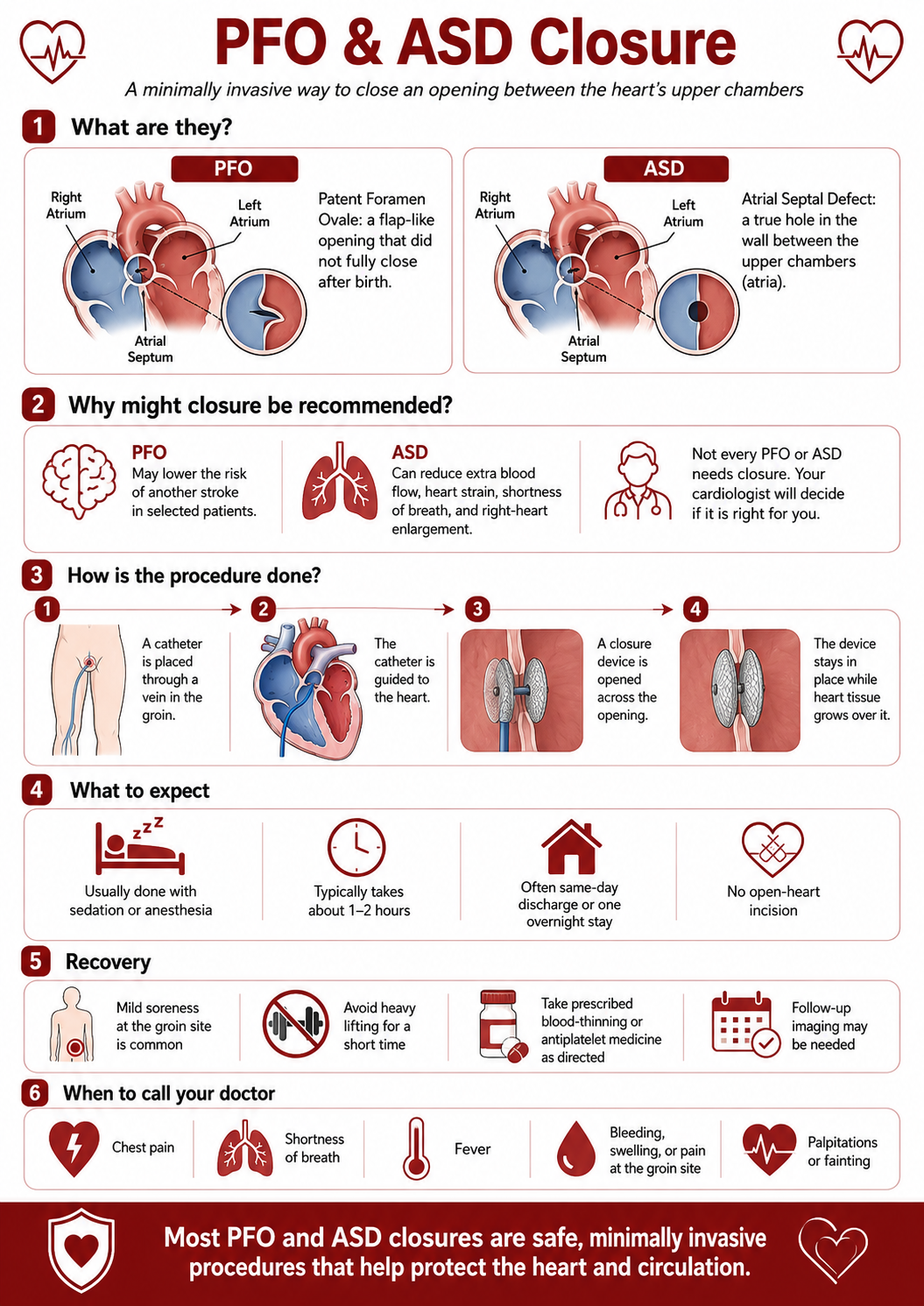
Your heart has four chambers, and a muscular wall called the septum separates the left side from the right. Before birth, every baby has a small flap-like opening in that wall, it's how nature routes blood while the lungs aren't yet in use. After birth, that opening is supposed to seal shut. PFO (patent foramen ovale) means that flap never fully sealed. It remains in roughly one out of every four adults, most of whom will never know it and never need to. But in some people, a PFO can let a small blood clot slip from the right side of the heart to the left, travel to the brain, and cause a stroke, often in someone young and otherwise healthy. When we find a stroke with no other explanation, a PFO is one of the first things we look for. ASD (atrial septal defect) is a true hole in the wall between the heart's upper chambers, present from birth. Unlike a PFO's occasional flap, an ASD is open all the time, letting oxygen-rich blood leak from the left side back to the right. Over years, that extra volume overworks the right side of the heart and the lungs. Patients may notice fatigue, shortness of breath, palpitations, or frequent respiratory infections, sometimes not until adulthood.
How Do We Close These Holes?
Here is the remarkable part. Through a small puncture in a vein at the top of the leg, we guide a thin catheter up to the heart. Riding on that catheter is a closure device, two soft, self-expanding mesh discs connected at the middle, folded down small for the journey. Guided by X-ray and ultrasound imaging, we pass the device through the hole, open one disc on the far side, pull it gently against the wall, then open the second disc on the near side. The hole is sandwiched shut between them. Over the following months, your own heart tissue grows over the device, making it a permanent, natural part of the wall. The catheter comes out, and a small bandage covers the entry site.
What Should I Expect?
The procedure typically takes about an hour. Most patients go home the same day or the next morning and return to normal activities within days. You'll take blood thinners or aspirin for a period while tissue heals over the device, and we'll follow up with ultrasound imaging to confirm the seal.