Structural Heart Disease Procedures
What Is Structural Heart Disease?
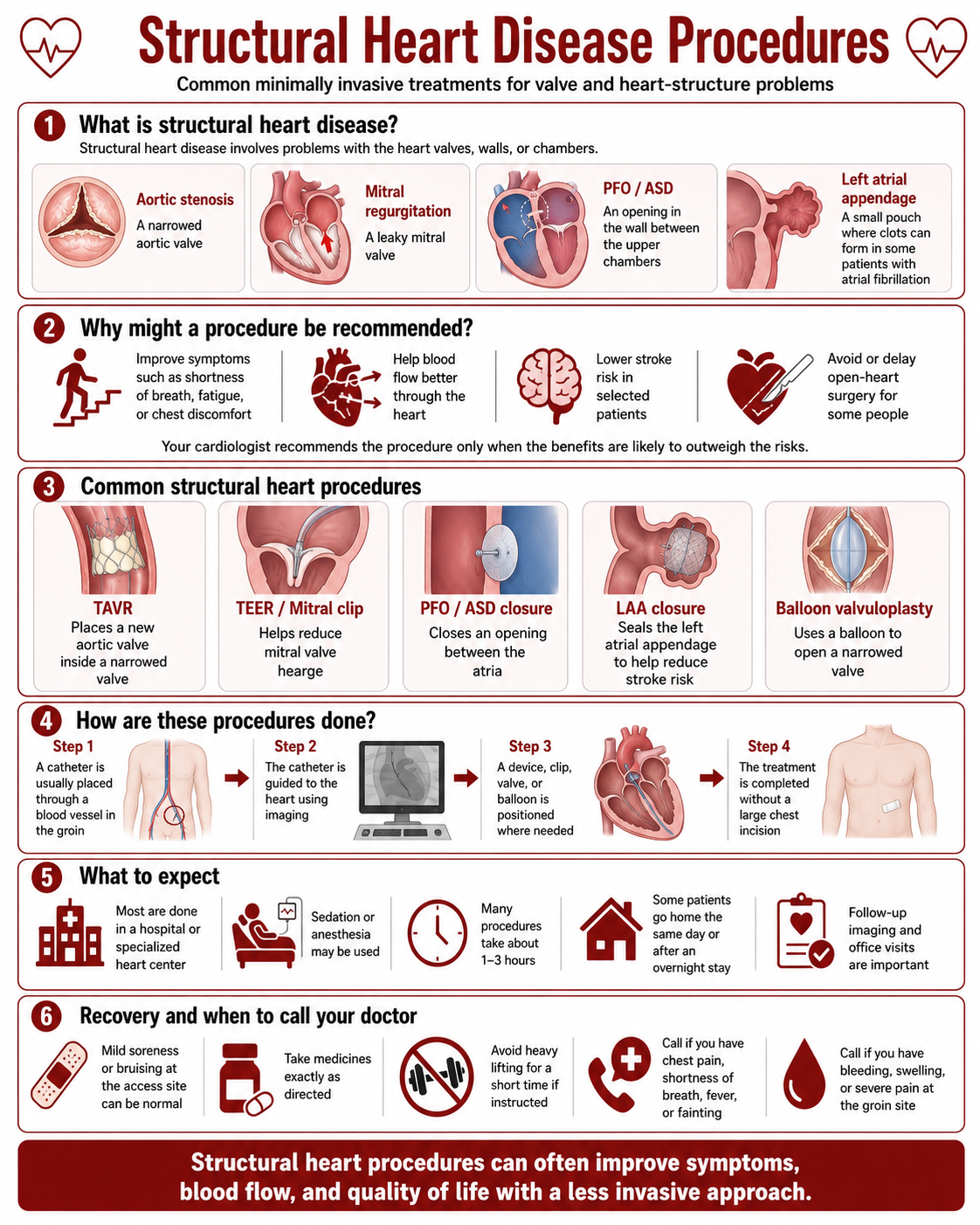
While coronary artery disease involves the pipes that feed the heart, structural heart disease involves the architecture of the heart itself, its valves, walls, and chambers. Some structural problems are present from birth; others develop with age or after illness. The most common include: Aortic stenosis, the aortic valve, the heart's main outflow door, becomes stiff and narrow with age, forcing the heart to push against it. Patients feel breathless, fatigued, or faint. Mitral regurgitation, the mitral valve fails to close properly, letting blood leak backward with every beat. Holes in the heart, septal defects such as ASDs and PFOs, small openings in the wall between the heart's chambers that can allow blood, or clots, to cross where they shouldn't. Left atrial appendage, a small pouch in the heart where clots can form in patients with atrial fibrillation, raising stroke risk.
How Do We Fix Structure Without Surgery?
Structural procedures use the same road system as our other work: a thin catheter guided through a blood vessel, usually from the groin, up into the heart, guided by advanced imaging every millimeter of the way. TAVR (transcatheter aortic valve replacement) delivers a new, folded valve through the catheter, positions it inside the diseased valve, and expands it into place. The new valve begins working with the very next heartbeat. What once required open surgery is now, for many patients, an overnight stay. Transcatheter mitral repair uses a tiny clip to grasp the leaking valve's flaps and help them close properly, often bringing dramatic relief from breathlessness. Septal defect closure delivers a small, self-expanding device that seals holes between the chambers, where tissue then grows over it naturally. Left atrial appendage closure places a device that seals off the pouch, reducing stroke risk and, for many patients, the need for lifelong blood thinners.
Who Are These Procedures For?
Structural procedures were first developed for patients too frail for open surgery. Today, after years of proven results, many are offered to a much wider range of patients. Every case is reviewed by a heart team, cardiologists, surgeons, and imaging specialists together, to choose the safest, most effective path for you.