Coronary Angioplasty
What Is a Coronary Angioplasty?
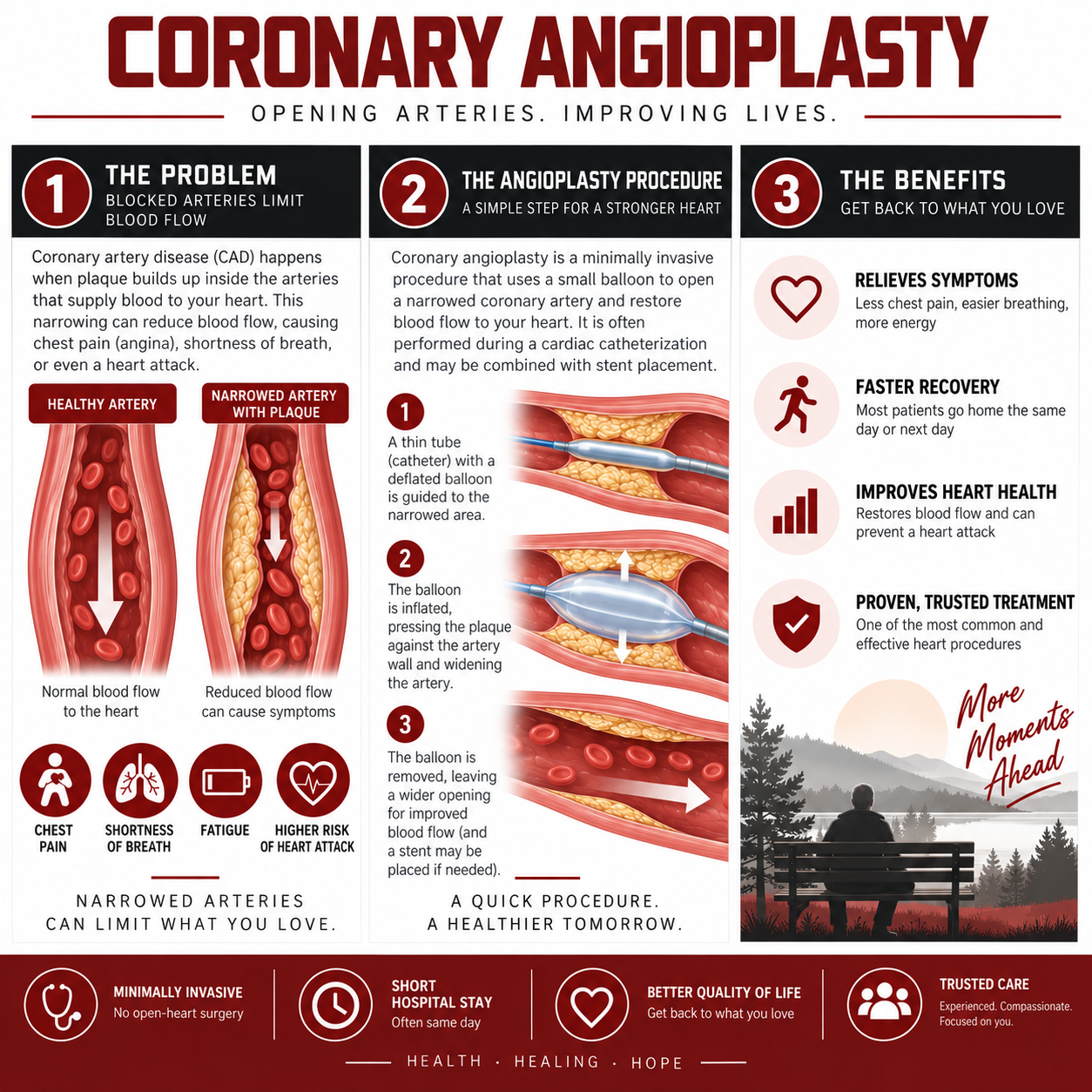
Your heart is a muscle, and like every muscle, it needs its own blood supply. That blood arrives through the coronary arteries, small vessels that wrap around the surface of the heart. Over time, a waxy substance called plaque can build up inside these arteries, narrowing them the way rust narrows an old pipe. When blood can't flow freely, you may feel chest pressure, fatigue, or shortness of breath. A complete blockage can cause a heart attack. Coronary angioplasty, sometimes called percutaneous coronary intervention, or PCI, is a procedure that opens those narrowed arteries and restores healthy blood flow, without open-heart surgery.
How Does It Work?
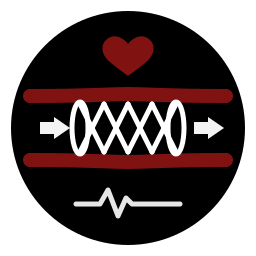
We begin much like a cardiac catheterization. Through a small puncture in the wrist or groin, we guide a thin, flexible tube called a catheter up to the heart. At the tip of that catheter is a tiny, deflated balloon. Once we position the balloon precisely at the blockage, we gently inflate it. The balloon presses the plaque against the artery walls, widening the channel so blood can flow freely again. In most cases, we then place a stent, a small mesh tube, often coated with medication, that stays behind to hold the artery open permanently. The balloon and catheter are removed; the stent remains, quietly doing its job for years to come.
What Should I Expect?
Most patients are awake but relaxed during the procedure, with local numbing medicine at the access site. Angioplasty typically takes 30 minutes to two hours, depending on the number and complexity of the blockages. Many patients feel relief from their symptoms almost immediately. Recovery is remarkably gentle compared to surgery. Most people go home the same day or after one overnight stay, and many return to normal activities within a week.
Is It Safe?
Angioplasty is performed hundreds of thousands of times each year in the United States, and serious complications are uncommon. During a heart attack, it is often the single most important treatment we can offer, every minute an artery stays blocked, heart muscle is at risk. Opening that artery quickly can save both heart muscle and lives. A Path Back to Living Fully An angioplasty is not the end of your heart health journey, it's a new beginning. Combined with healthy habits and the medications we prescribe, it can restore the energy and confidence that heart disease takes away.